How to Buy Land in Ibadan, Nigeria From Abroad: 6 Steps to Protect Your Money
Legal points reviewed by Ebunoluwa Oluwabukola Williams, Esq., on 20th October 2026.
You have worked hard abroad for this moment. Land back home. A house for your parents. Something solid to leave your children.
But you can’t get on a plane this week, and you’re not sure you should trust what you see on a phone screen.
So how do you buy land in Ibadan without being there?
You don’t hand over money on trust. But you don’t give up either.
Buying land in Ibadan, Nigeria from abroad is possible, and many Nigerians do it. The ones who succeed are not luckier than the ones who lose money. They simply do things in the right order.
This guide gives you that order in 6 simple steps.
The quick answer
Yes, Nigerians living abroad can buy land in Ibadan, Nigeria without being there. You need your own independent lawyer, a registered surveyor, a live video inspection backed by someone independent on the ground, every search done before you pay, a limited power of attorney so you can sign without flying, and payment only into a verified company or lawyer-held account, in stages. Most important: never let one person control the checking, the documents, and the money.
3 traps that catch buyers abroad
Trap 1: The video that proves nothing. A video shows you a piece of land. It does not show you who owns it. A Lagos property lawyer writing in TheCable makes the same point: a WhatsApp video, an agent’s promise, or a relative’s assurance is not proof that the seller has a good title.
Trap 2: One person doing everything. Your cousin finds the land, checks the land, and collects the money. Even honest people make mistakes, and nobody is there to catch them.
Trap 3: Paying before checking. “The price goes up next week.” “The owner needs cash today.” Sometimes it is true. But the rule that protects your money is simple: check first, pay later.
Step 1: Build a team where nobody checks their own work.
The secret of safe remote buying is to split the jobs so people cross-check each other.
- Your own property lawyer. Checks the title, reads the contract, and protects you. This must not be the seller’s or the developer’s lawyer.
- A registered surveyor. Confirms the location, size, and boundaries, and checks whether the land is affected by a government acquisition. Ask whether they are registered with the Surveyors Council of Nigeria (SURCON).
- An independent person on the ground. A trusted relative, friend, or professional who visits the plot, records dated photos and videos, and attends the allocation. They should not earn a commission from the sale.
- The seller or developer. Provides the land and the documents. They should never choose your lawyer or surveyor for you.
Tip: Pay your lawyer and surveyor yourself. If the seller pays them, you cannot be sure who they are working for.
Step 2: Inspect the land remotely (the right way).
A live video is useful, but only if you control it.
- Ask for a live WhatsApp or Zoom walk-through, not a recorded clip.
- Ask them to show the road leading in, the nearest landmark, the boundary beacons, and the drainage, and to turn the camera slowly all the way round.
- Ask for the survey plan and check that the beacon numbers on the plan match the beacons on the ground.
- Ask who lives, farms, or builds next to the plot and whether anyone is using the land now.
- Have your independent person visit the same plot and compare it with what you were shown.
Why this matters: a good video can still show the wrong plot. Your independent person and the survey plan make sure that what you see is what you are buying.
Step 3: Check the paperwork before you send a Kobo.
These are the documents you will hear about. Here is what each one means in plain English.
- Survey plan: a map of the plot with its exact boundaries and coordinates.
- Certificate of Occupancy (C of O): a document from the state government showing the right to use the land.
- Governor’s Consent: the governor's approval when land is transferred from one holder to another. Your lawyer will confirm whether it applies to your plot.
- Deed of Assignment: the document that transfers the land from the seller to you.
- Receipts and payment records: proof of how the seller got the land and what was paid.
A document can look genuine and still be wrong or belong to a different plot. So your lawyer and surveyor should run these checks before you pay:
- Land registry search: do the official records match what the seller says?
- Survey charting: the surveyor takes the coordinates to the government survey office to see whether the land is free or affected by a government scheme.
- Litigation search: Is there a court case over this land?
Also ask: how did the seller become the owner? I
Be careful with family land disputes and additional payment demands. In some areas, people claiming to represent the original land-owning families may demand extra payments, even after a buyer has paid for the land. Ask your lawyer to confirm who has the legal authority to sell the property and whether there are any existing claims, disputes, or outstanding obligations relating to the land.
Oyo State Note: The Office of the Ministry of Lands, Housing & Urban Development does land searches in Oyo State. This office is located at the State Secretariat, Agodi, Ibadan, Oyo State. The survey can also be chartered digitally using the Oyo State Digital Land Survey plan registry.
For an online search at the Oyo State Online Property Title Search portal, if the property has already been digitized into the state's databank, you can view ownership history, legal status, and liens almost instantly or within a couple of days right from home.
But for a Manual Land Registry Search at the Oyo State Ministry of Lands, Housing and Urban Development (located at the Secretariat, Agodi, Ibadan), the process usually takes 3 to 7 working days but can extend up to 14 working days if there are administrative backlogs or if records are archived manually.
Step 4: Sign without flying: Power of Attorney and the contract
You do not have to fly in to sign.
- Power of Attorney (POA): a legal document that lets someone act for you. Keep it limited and specific: what they can do and for how long. Do not give a broad POA to the same person who also handles your money. Ask your lawyer how to sign it from where you live (for example, before a notary or at a Nigerian embassy or consulate) so that Nigerian offices accept it.
- Contract of sale: your lawyer reads every line with you before you sign. Check the price, plot size, payment dates, what happens if the seller does not deliver, and any extra charges such as survey, legal, or development fees.
Step 5: Pay safely (4 rules)
- Pay only into an account in the name of a registered company or a lawyer-held account. Check the company on the Corporate Affairs Commission (CAC) public search, and make sure the account name matches your contract.
- Never pay into personal accounts of agents, relatives, or individual sellers.
- Pay in stages linked to progress: documents verified, then plot allocated, then original documents delivered.
- Keep everything: receipts, transfer confirmations, messages, and agreements.
Step 6: After you pay: allocation, original documents, and your title
- Physical allocation: your independent person watches the plot being marked out with beacons on your boundaries and records it on video.
- Original documents: the contract should say who holds your originals. Either they are sent to you by courier, or your lawyer keeps them safely for you.
- Perfect your title: depending on the purchase, this can mean obtaining consent, stamping documents, or registering your interest. Do not leave your documents unfinished for years.
Walk away if you see any of these.
- Pressure to pay today
- A price far below nearby plots with no explanation
- A seller who refuses your independent lawyer or surveyor
- Documents shown only as WhatsApp photos
- A request to pay into a personal account
- No live video or reluctance to let your own inspector visit
- “Family land” sold by one person without the family’s agreement
- No survey plan or beacon numbers
What this looks like at Gbajumo’s Court
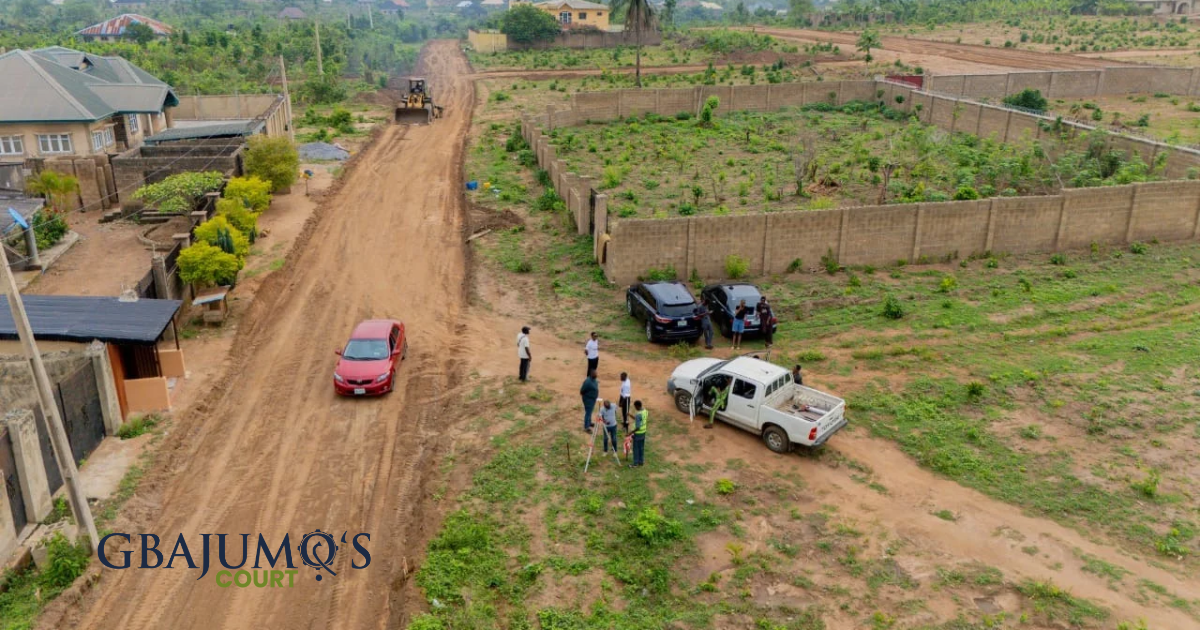
Gbajumo’s Court is in Omituntun Estate, Ajoda New Town, along Old Ife Road in Ibadan. Landmarks around the area include the International Airport, the Iwo Road Bus Terminal, Nigerian Breweries, and the Omololu Olunloyo Parks and Garden.
We are a developer, so don’t just take our word for it. Bring your own lawyer and check us the same way. Here is what we offer to make that easy:
- Title and survey documents available for your lawyer and surveyor to verify independently
- A live video inspection of your plot on WhatsApp, on a day that suits you
- Payment only into Elysium’s registered company account
- Plot sizes and prices: 300 sqm at ₦9,000,000 (initial deposit ₦1,000,000) and 500 sqm at ₦15,000,000 (initial deposit ₦2,000,000). [a flexible 1- to 6-month payment plan.]
Here is a view of Gbajumo’s Court and the area around it in Ajoda New Town, Ibadan. Click to Watch the estate video → This is a recorded overview, not an inspection of your own plot. To see your plot live, book a live video inspection below.
Book a live video inspection on WhatsApp →
Get the Gbajumo’s Court estate brief. →
Your free pre-payment checklist
Before you pay anything, can you tick every box?
- ☐ I have my own independent lawyer.
- ☐ A registered surveyor has checked the plot.
- ☐ I saw a live video, and my own person visited the plot.
- ☐ The land registry search matches the seller’s story.
- ☐ The survey charting shows the land is free from government acquisition.
- ☐ I know how the seller became the owner.
- ☐ My lawyer has read the contract.
- ☐ I will pay only into a registered company or lawyer-held account.
- ☐ My payments are in stages, with receipts.
Frequently asked questions
Can a Nigerian living abroad buy land in Ibadan? Yes. You can buy land remotely by appointing an independent property lawyer, arranging a live video inspection and an independent site visit, and verifying the title and survey documents. Use a Power of Attorney where required, and have your lawyer review the contract before payment.
Is a WhatsApp video enough? No. It shows the land, not who owns it. Use it together with a lawyer, a surveyor, the registry search, and your own person on the ground.
How do I prove I own land in Nigeria? Through your title documents, such as the Deed of Assignment, the survey plan, any required consent, and the registration of your interest, plus your payment records. Your lawyer will tell you exactly which ones apply to your plot.
Do I need to travel at all? Not necessarily. Many buyers still visit once, because seeing the land is a bonus, but the steps above let you buy safely without being there.
How long does it take?
Keep reading:
- How to Buy Land in Nigeria Safely in 2026: 9 Things to Check Before You Pay
- Lagos vs. Ibadan Property Investment in 2026: Where Should You Put Your Money?
- See Gbajumo’s Court: plots, prices, and estate details
This article is general information and is not legal advice. Always use your own independent lawyer before you pay for property.
Written by Patience Cyril Iwuoha
Content Writing Intern, Elysium
Comments
0Share your thoughts, ask questions, or join the discussion.
Leave a comment
No comments yet
Be the first to share your perspective, experience, or ask a question!